Sunday, October 2, 2022

In praise of the glory of the humble teenager as “hero”

In praise of the glory of the humble teenager as “hero”


A question many parents ask themselves, at least once, when their children hit those “problematic years”. Why would anyone remotely coherent and sane choose to work in a school, especially one with teenagers?

Schools are marvellous places; altruistic organisations where young minds are developed and children explore their philosophical outlook on life, the world and everything in between. Pragmatically, they are establishments where parents send children to be cared for while they work. Cynics say they are a place to send children so that parents can achieve some peace and quiet. 

Nelson Mandela praised education as:

The most powerful weapon which you can use to change the world.” 


Mandela recognised that schools help young people to learn life’s necessities: how to read and write, how to communicate effectively, how to make friends and settle disputes and play sports, act, sing, learn an instrument, pass exams, make jokes, share adventures and develop kindness, resilience and determination. Mandela also recognised education as a tool for the empowerment of young people.

Einstein was more critical of schools:


Education is what remains after one has forgotten what one has learned in school.” 

Does school make education more of a challenge? Arguably it does. Schools are full of teenagers; teenagers experiencing growth spurts, hormonal surges and huge developmental changes: physical, cognitive and emotional. 

The teenage years are notorious for impulsive behaviour, recklessness, disobedience, subversive rebellion, strange clothing choices, dyed hair or long hair or shaved hair or a combination of all three. Monotone answers (if given at all), excessive sleep, shouting, defiance, a loathing of authority and a desire for irresponsibility. Teenagers are the anti-heroes of developmental phases, as bad as the infamous “terrible twos.”


Which brings us back to the question: Why would anyone remotely coherent and sane choose to work in a school, with teenagers?


A recent British YouGov survey asked almost 1000 teachers to cite the reasons why they worked in the profession. The top reason? 83% of teachers said seeing pupils develop and achieve. What is all the more astounding about this figure is that teenagers are not renowned for their good judgement, sensible decision making or respectful love of authority. They are not renowned for heroism. And yet, as teachers we love our jobs, we strive for our best to honour young people’s decisions and support them in their learning, support them on their hero’s journeys.


Since Einstein’s school days, educationalists have become more aware of the cognitive developments in young brains. We know that the rational part of a teenager’s brain is not fully developed, and won’t be until the age of 25. Teenage brains work differently. Adults think with the prefrontal cortex, the brain’s rational part, the part that responds to situations with good judgement and an awareness of long-term consequences. Unlike adults, teenagers process information with the amygdala, the emotional part of the brain.


Teenager’s brains are still developing the connections between the emotional and the decision-making centre. They often experience overwhelming emotional inputs which they find difficult to explain because their feelings are more powerful than the rational aspects of their brains. This can lead to shouting with frustration, denying homework ever existed in the first place and hating everyone, everywhere, all of the time.


A teenager’s brain also becomes more able to think abstractly. They can make plans and set long-term goals, they can develop an interest in the larger world, concerned with philosophy, politics, and social issues. Teenagers see the potential for independence and control, and, conversely, peer influence and acceptance becomes more important; they compare themselves to their peers. This can lead to insecurity, joy and anger - sometimes all at the same time.


The teenage years are also a period of growth spurts and puberty. Teenagers grow at a fast pace and their bodies go through changes which can feel overwhelming, frustrating and sometimes frightening. They can be more like gawky, clumsy spiders than graceful, heroic athletes or dancers.


So we ask again, why would anyone remotely coherent and sane choose to work in a school, with teenagers?

The response to the question, for me, is that it can feel quite magical to work in a school and just observe, over the course of a year or years, as these teenagers become young people. It feels magical to watch teenagers’ brains develop, as they discover the breadth and beauty of the world, as they create opinions and battle their impulsivity and make mistakes and learn from their experiences. James Sallis, in his novel Willnot, describes this: “Think of the energies required to bend…into conformance and hold them there." At the end of this piece is a link to a poem which encapsulates the celebration of life as a teacher and the joys of working with young people every day. 

It is extraordinary and magical, as a teacher, to be a part of young people’s lives at this stage of their development. Being a teenager takes immense courage and energy, every single day, to face GCSE exams and A levels, to negotiate friendships and expectations and depths of feelings which seem inexplicable. Teenagers walk their paths every day with hope and joy and sometimes fear, yet journey on with  energy and resilience. We are privileged to see those children emerge from the chrysalis of their teenage years and become young adults. We teach in schools, with teenagers, because it is an everyday miracle, to experience the glory of the humble teenager as they walk their hero’s journey.


https://nationalpoetryday.co.uk/poem/it-is-everywhere/

Saturday, September 29, 2012

Back in the Desert

Been away for a while, mainly because of two huge life events. Those sort of life events that ironically enough, put life on hold while you carry on doing other stuff; feeding the kids, sleeping, driving to work, living! The two things were a death in the family and moving again. The death in the family was a sudden, unexpected, quick death. Sadly it was my mother in law that died. The reason I haven't written about the whole experience is because I found it all so sad and she is very much missed and it's been a difficult goodbye and so quick that I've never felt able to gather thoughts.
Then suddenly it was the summer, we had new jobs to go to (in a new country) and I was tied up with shipping and legalising documents and talking to the children about moving and telling friends and closing up our house in Spain.
And suddenly here we are in Dubai...we've been here just over a month and it's been a hectic, wonderful, hot and crazy time. We have a new home, new jobs, the children are in new schools. We're driving a hire car and relying on new friends for lifts to school and taking our kids to school.
Events have re-affirmed our faith in the best of human nature and the roads and driving in Dubai have reminded us of humanity's worst attributes (impatience, intolerence and road rage).
Moving around (this is our third move across continents in 5 years) tests everything about your life. Your sense of self, your relationships with family, your marriage. It test your inner resilience to the utter breadth and depth of being. I am full of gratitude that I am happy. Sometimes stressed but happy! The kids are great and my marriage is a wonder that fills me with joy every day.
There are a billion things I need to do, with our house (to make it a home), at school, for the new friends that we have made, with my children every hour of every day that I can spend with them. Moving continents stretches patience and tolerance and the bank balance...but it is also an exciting adventure, one that re-affirms our ability to enjoy the life we live and make the most of every single moment we have here. It's a time to re-evaluate and feel gratitude that we are here, now, enjoying life, writing a blog and rambling about life and death and love.

Friday, April 27, 2012

The bi-toed monster footprints in the sand

I love my walk on the beach. It’s become a wonderful ritual on my Mondays and Fridays off. I drop the children at their school bus then drive down to the beach, take a thirty minute walk along the sand and feel as if I have set myself up for a wonderful day.
I was a bit out of sorts this morning. We’ve had a busy week and even though I thought we weren’t late for the bus, as we drove past the bus stop I could see the other children all boarding and then horror of horrors, the bus slowly pulled away and we missed it. I didn’t panic, just followed the bus thinking than eventually it would have to stop again. It took a pretty convoluted route, stopped for a very short time at a major intersection (where I made the decision that I shouldn’t let my kids out – too busy, too quick.) Eventually, the bus stopped at a random roundabout with a convenient little parking place. There weren’t any other children waiting and then I realised that the clever coach driver had noticed the car following him along his convoluted route and had stopped for my kids. I was grateful but a little flustered and felt grumpy as I made my way to the beach.
There’s a magic in a beach walk though. Those waves dashing the shore work on an aural level through the brain fibres and along the emotional rivulets of your soul. The sky was grey but it didn’t matter. The sand was soft, forcing my body to work up just a little bit of heat and sweat as I worked at walking and my muscle memory worked at forgetting the tension of the bus catching drive.
It’s a sensory delight, the sights and sounds of the sand and sea, that inexplicable sea side smell of emptiness. The soft yielding sand and splash of cold salty tang. It’s a distraction for the body and the brain. As I walked I couldn’t help noticing the minor major details, the broken plastic chair that was a bit broken the time before last, very broken last time, has now disappeared. The small pretty shells washed ashore. The absence of those strange sea weedy little things that look like coconut shells but could easily harbour some watery creature from the depths of the scary deep. The smooth rivulets of clean sand that the tractor comes to tidy and the man in the tractor must take a great pride in his work because he always makes pretty patterns on the shore.
Today there was the added pleasure of the bi-toed monster footprints in the sand. There aren’t often footprints when I walk as I am at the beach fairly early. Today there were bare footprints that I puzzled at a while. There were clearly two sets, one walking up, one walking back, but they were so evenly spaced that the foot had landed in almost exactly the same place at times, creating a wonderfully neat bi-toed imprint in the sand. I had great fun imagining the monster creating the print with a set of 5 toes at each end of his foot.
The puzzle was soon solved by the appearance of the bare foot runner enjoying his early morning beach experience as much as me (but with more sweat). His running stride was impressively even and he was stepping on to his own footprints, Robinson Crusoe style. We said ‘Ola’ and he was away. I finished my walk, feeling refreshed to the very depths of my soul.

Friday, March 30, 2012

At a loss for words - morality and philosophy with children

Listening to the news with your children can be a dangerous thing. The headline a few days ago on the radio was: 17 year old sentenced to life in Florida for murder of two.
My son’s face was shocked. “17?” he said. “He murdered two people and he was only 17?”
Then my daughter joins in:
“Why did he murder those two people mummy?”
“I don’t know sweetheart”
“Was he a good guy or a bad guy?”
It is 8.30 in the morning, I am barely awake and my daughter is asking me about morality. I wish my brain would function more quickly, that I could think of the best thing to say to an 8 year old and a 6 year old as they ponder the realities of lives around them, of dangerous streets and disturbed people doing horrible things to one another. They are 8 and 6 and I want to love and protect them and keep them safe from harm but...
This is the real world...a world where bad things happen and I can’t pretend that it’s not true
Me: “I don’t know, but it sounds as if he is a bad guy”
My son is 8, in 9 years' time he will be 17. I look at him and hope that when he is old enough he won't ever want to hold a gun and won't ever wander, lost and drunk in an unfamiliar city and be cnfronted by a person with a gun. I hope that the world he lives in will be safe. They are both eating their breakfast, my son remains little overawed:
“17, he’s not even a man yet.”
And that seems a fitting end to our philosophical consideration of the news for the day.

Saturday, March 24, 2012

Teachers leave them kids alone...

I’m a teacher. Sometimes that feels like a hard admission to make, since teachers seem to be universally reviled by the British press. Only today, Boris Johnson links bad schools to rioting. It doesn’t seem to be long before teachers will be blamed for the current economic situation (probably because we didn’t teach maths properly!)http://www.guardian.co.uk/politics/2012/mar/23/boris-johnson-bad-schools-london-riots
For the last ten years, it seems that the teaching profession has been systematically abused by government and media agencies. Schools have been criticised for not being good enough whilst at the same time examination results have improved...but that’s been explained by exams becoming easier. Literacy and numeracy are quite consistently rated as not good enough with no headline space for the number of children in schools who speak English as a second language and whose only contact with English is through school. Meanwhile the current government has scrapped the investment in school buildings that started under Labour, so if children are being educated in damp and cold and overcrowded spaces, then that’s unlikely to change in the near future...but that doesn’t matter does it? Teachers and children working in decrepit buildings aren’t as headline grabbing as teachers causing riots!
Unfortunately, many people seem easily convinced by the media and government propaganda, believing that teachers have an easy life, work short hours and deserve the cynicism heaped upon them. Many people remember the dark sarcasm of their own classrooms and will never forgive their teachers for the suffering they caused.
So, let’s just look at the day in the life of an ordinary teacher:
Although school starts at 9a.m for most children, teachers will be in school at least half an hour before, photocopying, preparing materials, marking and responding to emails.
In the course of a school day, a teacher will come into contact with between 100 and 150 children.
Each class of children will be unique. Some children will work quietly and quickly, some will need plenty of additional support. Some will behave, others will not.
Can I just say it again....most teachers come into contact with 150 children every day.

150 children every day

The majority are lovely, some aren’t, but on any given day, 150 children are not going to be EASY.

On any given day, 150 children are not going to be PASSIVE (nor would you want them to be)

On any given day 150 children are not 150 adults following instructions

150 children will ask questions, will need help, will complain, and will shout (with excitement or frustration) will laugh, sigh, cry (sometimes), will hit out in anger, and will have a bad day.

150 children will swing on chairs, lose their books, forget their equipment, suffer bereavement, be ill, be happy, be unhappy, have fallen out with their friend...will love you or hate you...

150 kids will not let you, EVER, lose your focus because the moment your focus slips, someone is crying or shouting and you have a riot on your hands...so the WHOLE of your day is spent on maximum alert, monitoring every nuance and comment in the classroom- every potential conflict or joy.

And it’s your job, every day, to make sure that they are o.k. to make sure that they learn, to make sure that they can walk into the world with confidence, to make sure that they can pass an exam that will possibly have an impact on the rest of their lives...and you probably spend at least some of your summer getting ready for the new year ahead, planning and reading and resting your brain for a while.

As well as the 150 children, the teacher may also come into contact with their own ‘tutor group’; the teacher will closely monitor the tutor group students’ needs, socially, educationally, personally. It is the tutor’s concern if children in their group are under performing, unhappy or celebrating their birthday!

The teachers will also need to work together to ensure that they are aware of difficulties or problems, marking criteria, new government strategies and if there are biscuits in the staff room.
The teacher will make sure that the children have the knowledge and skills to pass exams, as well as the knowledge and skills to function in society. We try and make sure that the students we come into contact with every day are pleasant, can listen, can co-operate and treat each other with respect.

Lunch times are often spent helping students with work, offering lunch time clubs, spending time supervising the students on their lunch break, marking, catching up with e mails and planning.

More lessons after lunch

Schools finish at varying times, but most teachers will do some sort of work after school, either at home or at school. This may mean meeting with parents, planning, preparing the lessons, writing reports, marking or reading the new exam criteria to make sure everything is covered.

Holidays....you know, if you worked with 150 young people every day, trying to help them to learn, to pass exams and to behave appropriately for the society they will eventually be a functioning part of, despite their indifference, or antagonism or social disadvantages, then perhaps you too would appreciate a week off every now and again...it is exhausting.

And sometimes, you know that the children you teach will find it very difficult to get a job, that the economic climate will be unfavourable for them, that their family will not or cannot pay for the cost of university.

And you hope that any small thing that you can do with those children will help them to cope with the world they are about to travel into.

And you sometimes spend your evenings and your holidays helping those children to find work, suggesting voluntary arrangements that may help, giving advice, researching every possible avenue to help a child who gets help from nowhere else.

And sometimes you know that the students you teach have no hope that their future will be filled with learning. That school will be forever, the best part of their life because after school there's the dark future of unemplyoment and nothing to do.

And you’re probably not paid very much...but it’s a lot of fun

And exhausting

And you love it...because the children that demand so much and need a constant focus are also the warmest, most wonderful and enthusiastic and funny people that you know.

They are full of cynicism and greed for knowledge.

They love you and hate the system or they hate you as part of the system.

They love the time you give them and love or hate the books you make them read!

They make you laugh probably every day with their wry observations of life. They are the wisest and most naive people you know and you hope and fear for them in equal measure.

They thank you for their lessons and sometimes write down things that make you cry.

They are the future...

It’s just a shame that the British public seem to think, after every headline and every bit of bad journalism, that you do an easy job and you do it badly.

Thanks Boris, I hope that every single London teacher refuses to vote for you in the next mayoral election.

Sunday, March 11, 2012

The Bees by Carol Ann Duffy

It’s poetry, it’s wonderful. In this anthology Duffy deals with motherhood and life and loss. A mother herself, Duffy covers the sadness of the death of her own mother and ‘Premonitions’ holds the desire of everyone who has lost a loved one to unspool time backwards and experience those laughing moments in a shred history again.
The anthology also holds a love of Britain, its nature and geography, the poems The Counties, The White Horses and John Barleycorn drawing a nostalgic picture of a Britain deeply brewed in the honeyed history she creates with her word pictures. As an expatriate living in Spain, her words conjure the beauty of British landscape deeply imbued in our collective cultural memories. There are nods to Wilfred Owen in Last Post and Passing Bells, using the terrors of WW1 to look, perhaps, at the continuing wars that we are living through now with another’s eyes.
As the title suggest, Duffy is also concerned with bees, both as a symbol of what we may have to lose should our environmental destruction continue, but also as a symbol of the potential human ability to co-operate towards a better human good.
Finally, there are plenty of moments of laughter too, with Achilles a reference to David Beckham and plenty of poems in celebration of childhood and the delights of motherhood. Sometimes just celebrating nature and words themselves in a cacophony of assonance, alliteration and rhyme that Duffy is a true master of.
It’s a lovely anthology and one which I will return to with great frequency over the years to revisit the joys and the tears contained within.

How to be a Woman by Caitlin Moran

This is a terrifically funny book and it is wonderful to be presented with modern fiction which doesn’t think that the word ‘feminist’ is one to be avoided at all costs. The book is an autobiography covering Moran’s life to date and although some reviewers have belittled the fact that she does not mention some significant aspects of her life (such as winning writing competitions in her youth that allowed her to plough the lonely furrow of journalism with some support), they are overlooking the fact that autobiography has to be edited and of course Moran is not going to include every single aspect of her life. Our stories are self edited and adapted every day, every year. We tell people what we want to in order to fashion our stories and create our own personal narratives. Do I really care if Moran has adapted her truth? Not really, because the book still stands alone as a funny look at modern womanhood and the need for women to embrace feminism because of the steps we are yet to take.
In the light of the current presidential race in the states; with candidates like Santorum claiming the hard won victories of women, such as birth control and abortion, are towers that he is willing to bomb into historical collapse, it is all the more important that women in Britain and abroad recognise the journey that we have already taken. The rights and privileges that are seemingly enshrined in our lives but which we cannot take for granted as the extreme right, mad patriarchy and the ideologists who disguise their dogma under religious beliefs try to strip away the things that have enabled women to have good health, choices about their own bodies and a sense of independence. When we look at what we have, it is all too easy to strip away.
Moran’s book is not overtly political but comes from a place where the personal is political, where she takes aspects of her working class roots and gender and subjects them to a heartfelt and funny analysis, pointing out the insidious changes in our cultural life over the last twenty years that make a the ideals of a patriarchal consumer society’s ideals of the modern woman’s life a little more proscribed and a little more difficult to achieve. Moran makes us want to be the women we can be, taking difficult choices and not caring too much about underarm hair and the shape of our vaginas. It’s a funny, fun book and well worth a read.

The Night Circus by Erin Morgensten

This is a magical book about magical people and highly unlikely events. As the title suggests, the protagonists create a circus based on magic. The inhabitants are magical creatures performing tricks that the ‘normal people’ believe are extraordinary and in fact are magically real.
The clever conceit behind the story is that two young people have been chosen for their roles as apprentices to two mysterious and malevolent magicians. They undergo rigorous training in order to enter a magical battle which only one of them can win.  Unfortunately, they also fall in love with each other which presents them with the conundrum, how can they ensure that they both survive and their love survives the battle created by their masters? The answer is The Night Circus which evolves and changes and adapts as the apprentices (now applauded and supported by the readers).
It’s an engaging and wonderful read. As a fan of magical realism I was captivated by the characters and their various skills and abilities although the protagonists eventual solution to the problem of defeating their unconquerable masters, who until that time had never been defeated, was a bit too surreal even for me.
The cast of characters, including a magical clock, a disappearing man and a wonderful tent of shapes and sounds and smells, was a wonderful world, one which I did not want to disappear or end. Cleverly, the book includes an ardent team of Night Circus supporters, a team which every reader will probably support and want to join.

The Art of Fielding by Chad Harbach

The Art of Fielding by Chad Harbach
Don’t be fooled by the title and descriptions of this book as a ‘Book about baseball’ because it is far far more than that. I know nothing about baseball and I did find myself skimming some of the game descriptions (which can be a disadvantage when the plot mainly revolves around the successes and failures of the team). Nonetheless, the characters and interesting and engaging and at a very basic level, the friendships in the book demonstrate many heart warming aspects of solidarity, male bonding and competitive, testosterone driven achievement.
Some people may find the storyline a bit clichéd, as the main male sportsmen are drawn through the traditional story arc of rising success. The fact of the matter is that the reader can see the clichés and know what’s going to happen next, but that doesn’t mean we like the book any less because by that stage we are living the adventures of the main characters, training hard, playing hard, studying curveballs and statistics and playing great games. We are supporting our friends and telling them lies and living the complex lives of money, power and friendships that so often unravel after graduation.
The book covers the sadness of loss and the temptation in youth to stay in the place of safety that is University despite that phase of your life ending. The realisation in early adulthood that all of the things you would like to live in permanently, studying and living close to friends and being part of a team, may be transient.
The book struck a chord about the strengths of friendships. Friendships that continue despite age and loss and life. My husband still maintains close friendships with three friends from university (all boys, and still referred to as ‘The Boys’), I also sustain close friendships with three girlfriends from my own university days. These friendships have not always been smooth, we are people after all, we have argued passionately, been there through illness and death. The friendships remain: sustained in a deep rooted self perpetuating truth about love.

Wild Abandon by Joe Dunthorne

I may be biased about this book as it is based very close to my former Welsh home and the areas described could well be where my brother is currently living. Certainly the ‘old hippy’ labels that could so easily be applied to the family represented in the book could be stuck on to many people in rural Wales. In fact rural Wales seems to attract its fair share of eccentrics running away from the strains and stresses of city life; hippies, mad surfers, Tai Chi teachers, people living in yurts.
 I was once told of a ‘Mystic Triangle’ theory about lay lines creating a triangle around Swansea and stretching down around Stonehenge. Apparently this Cosmic Triangle creates great peace and tranquillity, which is why people, once there, rarely move away, partly because of the beauty of the Gower Coast and the verdant greenery and despite the (almost) constant rain. Apparently, Swansea is also quite famous for the variety and availability of drugs...who knows..
I have digressed. Wild Abandon is a funny novel detailing the family life on a commune, although the number of people living in the commune doesn’t seem to make it practical for the place to survive. Dunthorne draws a picture of all the negatives of a commune and is a great reminder of why one should never ever ever venture into communal living. The trials of teenage life are covered wonderfully, as are the adventures of the slightly younger brother in the book. There are drugs and alternative lifestyles and some closely observed comedic touches about marriage and the power of dictatorship to override democracy.
Dubnthorne also explores the complications of relationships in general, and in particular the difficulties of negotiating a collective of too many people drawn together for differing reasons, some seeking solitude, others support and companionship. Eventually and of course, ironically, many of the characters desert the commune for the comforts of ‘ordinary’ suburban living. They cannot live the ideology, as with many concepts, the theory of communal living is far more romantic and wonderful than the realities of sharing a fridge and a bathroom with too many people.
It’s a funny book and should be read by anyone considering communal living.

The Family Fang by Kevin Wilson

This book is based on the rather extreme concept of taking performance art to its very limits and living it, having children and integrating them into a life of compositions, performances in innocuous places like shopping malls or aeroplanes designed to create a response from the audience.
As a drama geek and a fan of modern political drama I had some understanding of the concepts the book is based on; that didn’t necessarily make it any more credible. I found it difficult to believe that parents would involve their children in such mad ventures...but then logically, parents do horrible things to their children, to a minor or major degree, every day, why should performance art be less believable than any other forms of abuse?
Wilson has made a good job of the characterisation, with the reader becoming absorbed in the difficulties faced by the grown up children of the artistic parents and left in a void of cruel unknowing when their parents have disappeared, are they dead or is this another piece of extreme drama?
The endless soul searching of the brother and sister of the family Fang was a bit too lengthy at the beginning of the book but the pace became more exciting after the apparent disappearance of the parents. My favourite parts were the descriptions of the family Fang performances, when the parents staged, with their children, their events and the reader waits with bated breath to see how the audiences will respond. The emotional highs and lows of performance are well documented as are the flaws, joys and tragedies of human nature and our responses to the people around us.
It’s a fun book, disturbing and funny in equal measure. Worth a read, even if some readers may find the aspects of performance art a little too obscure for their own liking.

Books

Ok, it's time for some book reviews, been neglecting them (not reading, just writing about them). In fact, been reading lots of very good books recently, far too many, so I am now obliged to work through the back catalogue of the Kindle, finding the ones I liked best and reviewing them here so that you lovely people can share....

Friday, February 17, 2012

Hot Chocolate

It's cold in Alicante at the moment, unseasonably so, I am told. The picture is of my daughter wearing her cow hat to keep warm in the kitchen. I don't like cold weather. Part of the reason for us moving here was to move to warmer climes so I am a bit grumpy! The sunny blue skies are a consolation, but it is very cold in the evenings, cold enough for having a duvet on the sofa upstairs for snuggling up with. Cold enough to wish we had already installed the log burner that we are planning for some future date when we have more money, (when August comes we'll find it difficult to believe why we ever need one).
I've had a busy morning today, the plumber has been, I've spoken to people about a random bill we may or may not have to pay for council tax, which seems to have been paid, but I need to go to the bank to clarify. The washing's been done, the kitchen tidied and I was feeling a bit busy and cold, so the heating has been put on and I have comforted myself with the best treat that Spanish culture can provide. A hot chocolate.
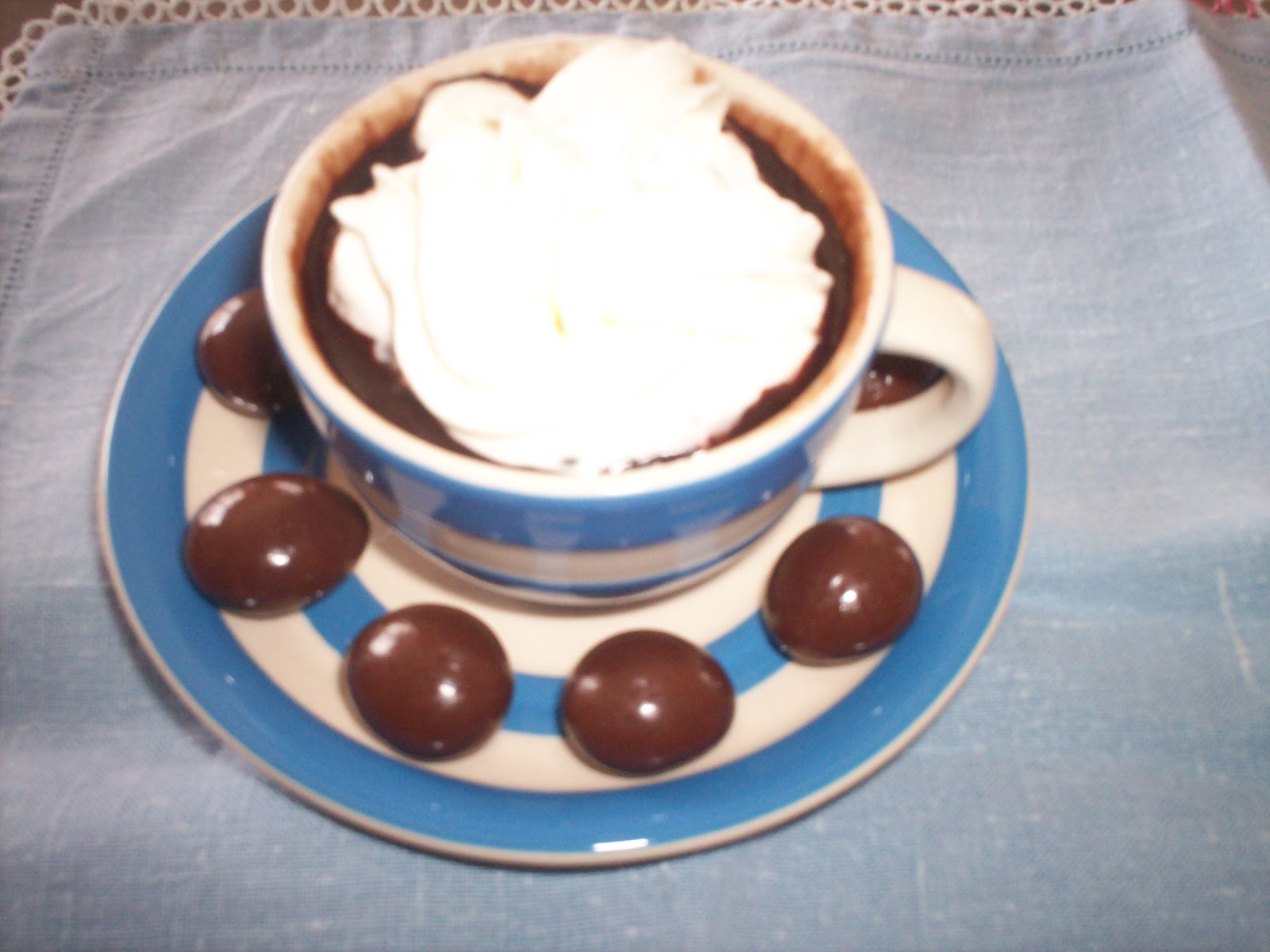
Here it is in pictorial form...

Feel much better now! In one of my Spanish classes, the teacher and I had a great debate about the origins of chocolate, he insists that it is Spanish, I countered that it's South American. He did some research and brought an article to the next class explaining the mixed origins of chocolate as we now know it - all in Spanish - which was a distinct disadvantage from my debating point of view. We eventually agreed that the origins of chocolate are indisputable South American but the chocolate that we now know and love (with added sugar and other flavorings) is Spanish. I have to say that the quality of chocolate here, particularly hot chocolate, is delightful. I am also currrently addicted to the Valor chocolate covered almonds pictured above. They were originally bought as a treat for Christmas, and have since been bought as a Valentines and now as just a cold weather treat! Lovely. Keep warm everyone.

Friday, February 3, 2012

Fragments of Family Life: the Garmin

The Garmin
Basically it’s a computer for your wrist. It’s a very clever computer, with GPS and stuff. It’s my husband’s, purchased as a ‘treat’ after completing his second marathon, in Paris. His first marathon was the famous London, a marathon that is now so popular that it’s massively oversubscribed and wouldn’t be a marathon to go for a PB (Personal Best in runner speak). His third and fourth marathons were Dublin and London again, with lots of half marathons in between when we were living in rural Derbyshire/Staffordshire, so plenty of lovely hilly climbs!
Whilst we waited for husband at the finish line, I was always amazed at the variety of shapes and sizes and ages of people completing the marathon – a number of old and wiry looking men and women as well as large people who looked more like rugby players than marathon runners but all seemed to enjoy the experience (we were usually watching at the finish line where the enjoyment is probably at its peak, as opposed to at the ¾ point where everyone is hating the run and their bodies and wishing that it would all end!)
His next marathon is going to be Madrid and, using his Garmin, he will have a pretty good idea of what sort of time he can hope to run it in, although it seems that marathon running is not an exact science as you cannot always factor in the ‘human nature’ element of the race: how you will feel, if you’ll need a poo, if there are thousands of other runners, how you will feel when you are running your heart out only to have a person run past you wearing a womble outfit etc.
I only know all this because I am married to a keen, if not devoted runner. I can barely run a kilometre. I could probably walk about 10kms but running has never been my favourite sport. In fact I dislike running intensely and didn’t mind at all when a boyfriend at university pointed out that I was built for comfort and not for speed because, for me, it’s the truth. I’m an advocate of this School of life: why run when you can walk? Why walk when you can sit down? Why sit if you can lie down? I’m not averse to a bit of exercise, but I like it to be a walk, perhaps followed by a nice pub lunch or a lovely ice cream at the end as a treat.
I do like a good old competitive game of netball or basketball or rounders. Nothing like a bit of team sports to get the adrenalin going but I am pretty rubbish at sports in general and feel sorry for any team that may have me in its midst because I’m not that good. Not too good at tennis or badminton either. I like a swim, particularly a swim with flippers that let you skim through the pool like some magic woman from Atlantis. I think my favourite sport at the moment is a squash and a squeeze with my kids. This involves me tickling them heartily and sometimes ends in a pillow fight and wrestle – it’s good aerobic exercise. Unfortunately, my children, now 6 and 8, are almost strong enough to overpower me, so that work out may disappear soon as being a dangerous sport.
My son loves football and is also showing an interest in running, something his dad is happy to encourage. They have recently embarked on Sunday run together and to my shame, my son can run 5km now, an easy 4km more than I would be happy with. My daughter has the energy of a 6 year old and just runs around everywhere anyway, from the moment she gets up in the morning to her reluctant bedtime. We should really strap the Garmin on to her wrist one day to see how many kms she covers.
When husband first got the Garmin I considered it as a possible toy to get me motivated to start running, I was, for a long time, an aspirational runner, thinking that I could and would grow to love it with perseverance. Now I just accept that the Garmin is my husband’s toy. He is the marathon runner and I am proud of his achievements and will be happy to cheer him on at the finish line in Madrid. Next time you watch the start of the London marathon, watch the runners on the starting line, a good percentage of them, on starting, will push the little buttons on their Garmins to start inputting the data - some of them will have little bleeping reminders throughout the race to remind them to slow down or speed up and will use the Garmins throughout to monitor their progress and aim for a P. B.
They're all setting their watches!! Possibly Garmins!

I am happy to observe without participating; I am a woman of many talents – running just isn’t one of them.

Saturday, January 21, 2012

Lessons my mother taught me – how to be fearless

I have a rubbish memory, so I have no idea how old I was. Older than 10 certainly and probably closer to 14, an awkward age full of hormones and crossing thresholds of responsibility and innocence.  Salem’s Lot was on TV. and for some reason my mother had agreed that we could watch it. Having no interest at all in films and television programmes she had no idea that the program was a film about vampires. I’m guessing that the film had been advertised extensively on TV. and that maybe it had been discussed at school, so I’m sure some relentless nagging on my part was part of the reason why we eventually watched it. It had David Soul in it for goodness sake, of Starsky and Hutch fame...so what would be the harm in that...
Trawl the internet and you will find endless horror stories of kids having the absolute crap scared out of them by the film. It looks kind of dated now but at the time, the vampires were a nasty, scary breed and the horror genre had not yet been satirised by post modern 90s. Despite the fact that I often loved Hammer House of horrors films (often shown, bizarrely, on a Saturday or Sunday afternoon slot on BBC1 or 2!) I was not immune to the horrors in the classic Stephen King story and I was terrified. One classic scene featured a gaunt and once beautiful vampire scratching at a window, waiting to gain entry and rip David Soul’s throat out.
When we went to bed that night, I uncharacteristically asked my mother if I could sleep in her room. I was not really an easily frightened child and mum didn’t usually encourage that sort of clinginess, but in this instance, she agreed that I could make a little bed for myself next to her bed, on the floor near the window. We got ourselves comfortable and mum turned the light out. I was feeling snug and warm in my little bed, safe in my mother’s protection because everyone knows that the primal instinct of a mother is to protect her babies from any harm, from cold and chicken pox to supernatural vampires. As I was just drifting off to sleep, I heard mum’s voice in the dark.
Mum: “You know why you’re sleeping next to the window don’t you?”
Me: ”No, why?”
Mum: “So that when the vampires come through the window they’ll get you first.”

Friday, January 6, 2012

Epiphany, chaos and misrule...

6th January in Spain and it’s Epiphany. The day when the three kings visited Jesus and offered him gifts. The day when traditionally, Spanish children also receive their gifts from their families although increasingly, many Spanish families are now celebrating Santa Claus on the 25th December too, making it an expensive time of year.
For language geeks like me, epiphany is also an interesting time and word and idea. The concept of an epiphany is the sense of gaining, perhaps quite suddenly, an intricate and perhaps externally influenced understanding of a concept. An epiphany suggests to me a gift from the gods or supernatural elements looking out for us little people and giving us some insight into life the world and everything.
At the same time, however, an epiphany doesn’t come without some sort of prior work. We can’t suddenly grasp huge concepts of physics or matter or the universe without some prior building blocks and thought.
That’s why an epiphany is a great concept. The marriage of some supernatural, magical event or understanding in our lives after some serious thoughtfulness and meditation or maybe some serious physical graft or just some hard bloody work.
An epiphany is a major thing, an opportunity, a light shining. That doesn’t necessarily mean it has to be a big thing in our personal worlds. It may be a decision to change something in our lives, to be more charitable, to be honest or enact a kind moment every day. The small stuff begets the big stuff, emotionally, physically, spiritually.
The celebration of Epiphany also coincides with Twelfth Night, traditionally the time to put the decorations away and prepare for the year ahead. Twelfth Night has been a time for the final acts of chaos and misrule as we celebrate the end of the disorder started earlier in the year (at Halloween).
The origins of Twelfth Night and Epiphany are complex, with religious and pagan ceremonies coming together in this significant date after Christmas. They may mean different things to us all, the end of Christmas, the recognition of a New Year ahead, the return to order after dark winter chaos, the celebration of the birth and recognition of Christ as the son of God.
I don’t think it matters what you may be celebrating or thinking about today, I just hope that we can all take a magical bit of the meaning of those ingredients.
Personally, I’d like to combine a bit of pagan chaos energy with a moment of clarity, an epiphany which will allow me to make changes for the better in the New Year. Perhaps it’s enough; if we believe in it, in combining those elements together today; magic will happen.

Wednesday, January 4, 2012

Lego

Husband has been on a seemingly never ending Lego quest this week. It was the after Christmas quest to put some order back to chaos. We have spent far too much money over the last 5 years on Lego. It’s an easy fix for birthdays and Christmas for my son as he loves Lego and Star Wars and Indiana Jones. So the perfect combination is Lego Star Wars figures or space ships
Unfortunately, what seems to happen with Lego is that the space ships are made in an excited flurry on first receipt...then over the course of a few months, they are dropped and bits chip away and friends come to visit and decide that making your own models out of various bits of broken space ship is far more interesting than keeping the original bits together.
Eventually you end up with a pile of Lego in a box, which is fun and leads to hours of imaginative play but what happened to that great space ship?
Thankfully, we are a family with two semi control freak teachers, so we keep the instructions...
So husband has been using the instructions to gather up all those teeny weeny little bits of Lego from the box to recreate the space ships.
We did it last year too....
It’s arduous, takes hours and is satisfyingly wonderful when you manage to get a space ship back!
We’ve been colour coding this year...collecting all the black, dark grey, grey, white, red , brown and cream pieces into separate zip lock plastic backs (easier for finding pieces). Sounds simple doesn’t it? Until you get a bit compulsive about it all...we now have a zip lock bag for pieces of ‘men’ and accessories and another bag for ‘interesting and strangely shaped and transparent’ pieces that don’t necessarily fit into colour coding or ‘men’ accessories categories....
My son is in charge of putting the appropriate men together with the ships and he has a surprisingly good memory for which particular bits belong to each ship (they all look the same to me..)
We’ve turned into LEGO geeks.....
Spent the morning making a space ship today... and yesterday. I suppose that’s what holidays are for when you have young children. Next week will be back to work and normality without the luxury of hours of leisure time and the Star Wars figures will go back to their organic and natural decline back into Lego blocks. Meanwhile my daughter’s Playmobil is far easier to store and play with...although her animal menagerie from last Christmas could do with reconstructing again...

Saturday, December 31, 2011

Happy New Year

It’s the end of another year, a time for reflection, for resolutions and for gratitude.
What a year 2011 has been. For many a time of radical change, some good, some bad and some as yet unresolved...
In our family, my daughter has lost two of her bottom teeth; my children’s grasp of Spanish is improving every day.
My son has learned how to tie his shoelaces and has read The Hobbit. They are both taller.
I have started to come to terms with using the past tense in Spanish (even though there seem to be a hundred different verb tenses)
The global economy has been in some sort of boxing competition where the euro, the pound and the dollar have each taken a good old battering.
I’ve been keeping a (fairly) regular blog
Life has been a strange blend of thinking about life and wondering what it means to be a wife and mother and grieving daughter (my mother is in the horrible stages of dementia that robs the personality and the mind leaving a strangely resilient physical body behind) and have a sort of career at 42.
Political rant (skip two paragraphs if disinterested)
Britain has been in the throes of Tory rule again. I can only read about Conservative policies and despair as Britain seems to return to the bad old days of social deprivation and cuts that have an impact on those who are most needy. The sad thing is that we can look back on Labour government and rue what was not attempted or achieved in the golden years of opportunity.... As a determined socialist, my heart will forever sway to Labour but historical hindsight can only leave us voters bitter at the opportunities lost...where else can our political hopes lie if not with the party that is meant to represent the people?
The world seems to be undergoing a change as the Arab Spring swept the Middle East and yet so many important things are still not addressed by our governments. The environment is increasingly ignored, people are paid ludicrous amounts of money for unintelligible jobs whilst others are paid a pittance and increasingly denied any workers’ rights that have been battled for over decades.
Come back here if you're avoiding political rant!
Importantly, a new year is a chance to contemplate the contents of our drinks cabinet. I am not a big drinker, I have always been a cheap night out...so it is a bit silly for me to even look at the range of spirits available in our cupboard (most of which were gifts, or purchased for visitors..) because I will probably just briefly sup on a very very small selection.
So, husband has the champagne lined up, I fancy a nice glass of amaretto and maybe a small port, that’s probably me sorted for the night....
We are at home tonight with our kids. No visitors this year. We could have gone into Alicante for a venture into the Spanish territories of keeping the kids out late and celebrating in the streets...but our British sensibilities are more inclined to snuggle up safe and warm at home.
I am glad to in the bosom of our small family. Safe, content, warm. We have so much to be grateful for at the end of this old year, our health, our home, our children, our jobs. Our friends are far flung and spread across the globe, but they remain our friends and we love them all.
Best wishes to everyone for the New Year, may it be one filled with the simplest and best three wishes that anyone can ask for from the magic genie of the New Year: health, happiness and wealth (and a lovely selection in the drinks cabinet! – that’s four, never mind!)
Blwyddyn Newydd dda
Happy New Year
Feliz ano nuevo

Friday, November 18, 2011

Decades of Difference: In your lunch box

The First Decade
In this first decade your parents were probably very concerned, if not obsessed, by your nutritional needs. As a baby your lunch may be most conveniently attached to your mother in the form of her breasts, but that doesn’t necessarily guarantee convenience in all respects because, let’s face it, people don’t really like to see breasts out in public when they’re serving their primary biological function of feeding a baby. Bare breasts on a beach? Yes! Breasts in a newspaper? Fine! Enormous breasts on the covers of dodgy magazines? As long as they’re on the top shelf, why not? Breasts feeding babies anywhere public? No thank you say the majority of the great British public.
Your first decade may be fantastic for you as you progress from milk to mush to puree and finger foods. You discover the delights of texture, taste and temperature on your tongue. You watch the varying expressions on your parents’ faces as you delightedly or accidentally fling food all over yourself, the floor, the table and your chair. Meanwhile your parents will be fraught with the childrearing debates: when to wean? Breast or bottle? Peanuts or not? When to try shellfish and honey, how much chocolate? Are crisps allowed in lunchboxes?
These nutritional debates and conflicting scientific evidence hover in the background as you discard the apple, eat sand and worms and soil and any insects you can find, or, in the latter part of the decade, buy chocolate and crisps from the corner shop.

A Birthday Cake = SUGAR!!

The Second Decade.
This decade is a time of choices. You will become increasingly confident in your eating habits and desires. You may deliberately move away from your parents’ choices towards more radical ways of eating. The teenage years may be a move to the quick calorific pleasures of fast food. The ingestion of salt and fat doesn’t worry you. The years of heart disease and weight gain concerns are a distant shore.
Your independent choices may lead you down new paths; vegetarianism, veganism. A love of processed white bread. You may become a devoted carnivore or a fast food aficionado. Your student years may be dominated by baked beans, cheese and bread and as many imaginative variants of those as are possible. In the latter part of this decade you may move away from lunch altogether with a love of snacks, pot noodles, cups of tea and biscuits the pleasures of your culinary day.
The Third Decade
These may be the experimental years. You probably have your own kitchen now and you may have requested some nice kitchen goods for your housewarming or wedding. The life and lunch experiment involves seeing which electrical goods lay dusty and disused in your kitchen cupboards and which ones actually get used. Sunday lunch for 4 or 10 may be an excited reality not an ambition. If you’re lucky, you will have disposable income to spend on quirky experiments like truffle oil, specialist salts, Spanish sausage and organic meat. Some of these ingredients may languish in your cupboards, whilst others will be loved and cherished and promoted from lunch time luxuries to weekly essentials. You will either delight in or desist from visiting your staff canteen, depending on the quality of food and drinks. You may even make your own lunch and take it into work, perhaps in an elaborate collection of Tupperware that includes hummus and other dips and bread with seeds. You will probably become more of a tea or coffee snob in these years, trying Earl Grey and tea leaves in a teapot , coffee may be ground and brewed and served in the smallest imaginable cups with froth...or the expensive coffee machine will be consigned to the dusty cupboard with the juicer and the dried sun blush tomatoes.
The Fourth Decade
You can no longer eat what you want, when you want and laugh at the consequences. You have to think about salt and fats and sugar and calories. The weight seems to accumulate far more easily around your middle without ever going away again.
Your taste for wines and exotic ingredients develops. You may order an organic vegetable box that gives you enough celeriac in a season to feed a family of twelve. You may start to source your meat carefully, buy organic eggs or maybe even keep your own chickens. If you have children, you care enormously about what they eat too. You like to eat lunch in restaurants and have friends around at the weekend. If you eat at work you probably bemoan the lack of quality of the ingredients and the fact that you don’t know where the meat comes from. Your hummus and dips have become low fat and you try to avoid bread when you can. If you are a mother you are traumatised between breast is best and breast is impossible for some mums. The guilt may be overwhelming. In fact feeding your children may become an overwhelming source of anxiety as conflicting headlines compete to tell you what’s best. It’s bad enough to make you buy a new coffee machine and enjoy more glasses of good wine at Sunday lunch time than you probably should. And if you don’t have kids, you have a couple of good glasses of wine or real ale on a Sunday afternoon and worry about your waistline or the size if your hips or your alcohol consumption per week or your cholesterol or blood pressure instead.
The Fifth Decade
Your lunch habits are probably indelibly fixed by now although you may, on occasion, attempt to convert to weightwatchers or healthier meals. Sometimes it’s just too hard to drag yourself away from the pleasures of alcohol and saturated fats and salts and sugar. Your doctor may be advising you against your traditional Sunday lunch but it may be the final ritual you share with the children who have left home and return for good food and company on a Sunday afternoon.
You may be divorced and lunch may have become a small delight for one or a treat you share with friends. It may also be a chore cooking for one after a life time of preparing meals for a family. Your appetite may be diminishing as your taste buds age. Your mid life crisis or menopause may leave you with unexpected intolerances to alcohol and coffee. You may have given up caffeine altogether because of the adverse impact it has on your sleep. You may still eat in the work canteen, but mainly salads. Or the work place lunch may have become your sole meal of the day as when you arrive home to an empty house and a kitchen full of dusty gadgets that have no use any more, you are too dispirited to do anything other than eat a crisp bread, or bite into an only slightly shrivelled apple before going to bed.
The Sixth or Seventh Decade and Later
Do you eat lunch any more? Do you cook? If you’re lucky you still love and enjoy food. Perhaps you still experiment with foods to find the exotic lunch. You may have turned the corner when worrying about what you eat seems nonsense and you may show a reckless disregard for calories, sugar and salt. Foods from your childhood may be a lovely comfort, fish and chips, rice pudding. You may have troublesome teeth and avoid anything that requires too vigorous chewing. Your fruit may be cut up.
If you are unlucky your food choices are made for you and are guided by institutional rules rather than your individual preferences. Meals may not have any flavour or texture for you when they are made by other people or you may enjoy the sweetness of the pink wafer biscuit that you never would have purchased for yourself but which is a staple with the tea at your old folks’ home. Your appetite may diminish completely in these years and you may have to be cajoled to eat anything at all. You may eventually lose the ability to feed yourself adequately although you may still enjoy a nice cup of tea.


Monday, November 14, 2011

Fragments of family life.

This is Bobby, he is my daughter Aoife’s most loved toy. Sadly he is fraying badly on the ears, the hands and feet. If you look closely, you can see his rather chewed looking toes. My daughter doesn’t seem to mind. His blanket has fallen off numerous times and been replaced in a variety of positions. At present the blanket is back to the original setting, his tummy. His ears and nose have been fixed several times, only to have the cotton chewed off by daughter
He is adored. We realised quite early on (at six months – more on that later) that Bobby was becoming precious. So we bought another Bobby (named Bob Bobby) as a possible alternative in case of Bobby loss. It soon became evident that Bob Bobby would never replace Bobby. As you can see from Bob Bobby's picture, above, he is rounded and undamaged with no fraying bits at all.
Thankfully, we have never lost Bobby and at present, Bobby is under house arrest to prevent future possible losses and hysteria. Initially, we thought that Bob Bobby had been rejected because of the colour difference, so I was quite excited a year later to find Annie. Sadly, she too has never found a place in our daughter’s heart. Bobby is the teddy and for a few years, all other toys, when presented for naming, were named Bobby. If we had another child, male or female, my daughter would want to call her new sibling Bobby.
The reason for this enduring love? When my daughter was 6 months’ old she contracted meningitis, the scary one. Meningococcal meningitis. She had a nasty cold that didn’t go away, then one morning she was limp and grey and we rushed her to hospital. Everything after that is a bit of a tearful  blur. We were in France on holiday at the time, which made the whole experience more surreal.  

The facts I remember are: Leaving the house in the middle of breakfast with a half drunk cup of tea on the kitchen table beside a bowl of uneaten cereal and the dishes in the sink. Calling our friends (who were arriving that day for a holiday) to tell them why we wouldn’t be there. They still describe the scene they found as the Mary Celeste kitchen

Being told immediately that she was very ill and needed to be transferred by ambulance to another hospital with paediatric facilities. We followed behind the ambulance in our car

They gave her a lumbar puncture to take fluid from her spine. We were asked to leave the room.

Being told by a sympathetic doctor that yes, it was very serious, as I collapsed into a hopeless heap after they confirmed the diagnosis

Our friend Mark came to collect our son Owain, who was three at the time and pretty confused.

A transfer for Aoife from one hospital to another in a helicopter, there was only room for one person on the plane with her; the medic, so we drove.  The silence between us and the unasked question was whether she would survive the journey.

We sat with her, day and night, for 15 days. Thankfully our friends Nick and Nikki were able to look after their own two children and Owain, and us, in a kind of numb disbelief.

Aoife was put into a medical coma. Catheterized, put on a ventilator. Basically they shut her body down so that her brain could rest and try to fight against the meningitis, with the aid of lots of lovely modern medicines, antibiotics and opiates.

She had lots of tubes going in and out of her body. She was alive, surviving, fighting.

The high dependency unit for brain injuries can be a very sad place. Hollow eyed people pass each other wordlessly, not wanting to share hope or loss.

The medical staff in the hospitals in France were unfailingly wonderful.

When eventually she started to recover, we stopped holding our breath and started eating properly and started smiling. I still cried every journey to the hospital to take over from my husband, not knowing what to expect.

We were told that we could take toys into the hospital and put them in her cot. Bobby was purchased on the way home at an enormous supermarket.

Eventually the tubes were slowly taken away. Our girl started coming back.

We were lucky. Aoife is alive and well. She is a stubborn and determined girl of 5 now. She had health and developmental checks for two years after her recovery, to check her hearing and her progress. She is fine. 


                                      Aoife in the kitchen in France, a year after the meningitis scare

Aoife this year at home in Spain

And Bobby...well Bobby was there with her, not from the start but from the recovery. He has been her companion ever since. He is smelly and battered and falling apart at the seams (literally) but he is a best loved toy. Bob Bobby cannot replace him and Annie cannot replace him, he is her best beloved and we tolerate him and love him almost as much as Aoife does because of the survival that he represents.